

Some goodbyes take time. And sometimes, the heart begins searching for a new way to honor someone we love.
There is an urn somewhere in your home.
Perhaps it rests on a shelf, surrounded by a photograph and fresh flowers. Maybe it sits in a special room, on a piece of furniture no one ever moves, or inside a carefully stored box that has remained untouched for months.
Sometimes, you look at it with tenderness. Other times, it brings a sadness you still cannot quite put into words.
Days have passed. Seasons have changed. Perhaps even years have gone by since that final goodbye.
Life has continued, although it has never been quite the same. You have learned to live with their absence, to remember without crying every day, and to find small moments of happiness amid the longing.
And yet, one question remains:
What should we do with their ashes?
It may seem like a simple question, but it carries profound emotional meaning.
Because when it comes to someone we love, choosing a final resting place for their ashes is about much more than making a practical decision.
It is about how we wish to remember their life, what meaning we want to give their farewell, and how we hope to preserve their legacy.
And as another year begins to draw to a close, perhaps that question has found its way back into your thoughts.
Not because there is a deadline for saying goodbye.
But because the end of the year often invites us to look back, reflect on everything we have experienced, and consider the things we still wish to approach with love and intention.
Why Do We Keep a Loved One’s Ashes at Home for So Long?
After cremation, many families choose to bring their loved one’s ashes home.
Sometimes, it was the person’s expressed wish. Other times, it is a temporary decision while the family searches for a meaningful final resting place.
And sometimes, we simply do not know what to do next.
The urn arrives at home during one of the most emotionally difficult periods of our lives, and suddenly, we are faced with a decision no one ever prepared us to make.
Should we keep the ashes?
Place them in a memorial sanctuary?
Arrange a ceremony at sea?
Or wait a little longer?
Sometimes, months pass before we can even begin to talk about it.
And that does not necessarily mean we are avoiding reality.
Grief is a deeply personal experience. Some people feel ready to make decisions relatively quickly, while others need more time to understand what they truly want.
Ashes can also take on profound emotional significance.
For a daughter, keeping her mother’s urn may represent closeness. For a spouse, it may symbolize a love story shared over decades. For an entire family, it can become a meaningful reminder of the memories that continue to bring them together.
Keeping ashes at home can be a valid and comforting choice. But so can deciding to give them a dedicated memorial space when the family feels ready.
Is It Bad to Keep a Loved One’s Ashes at Home?
This is one of the most common questions families ask after cremation.
Different religious, cultural, and spiritual traditions hold different beliefs about cremated remains.
Some traditions emphasize the importance of a designated resting place. Others find meaning in keeping ashes close or honoring a loved one through a ceremony connected to nature.
From a psychological perspective, there is no universal rule suggesting that keeping ashes at home is inherently harmful to the grieving process.
Likewise, placing them somewhere else does not automatically create emotional closure.
What matters is the meaning that each person gives to that choice.
Before making a decision, it may help to ask yourself:
Does keeping their ashes at home bring me comfort, or am I beginning to wish for another way to honor their memory?
Perhaps your answer is to keep them exactly where they are.
Or perhaps it is time to begin exploring other possibilities.
Both choices deserve understanding and respect.
The End of the Year and the Emotions That Return
November and December are often filled with family gatherings, photographs, traditions, and memories.
We begin thinking about the celebrations ahead, the people who shared the year with us, and those whose absence feels especially present during the holidays.
There are empty places at the table.
Recipes that someone no longer prepares.
Songs that remind us of a different Christmas.
And moments when we catch ourselves wondering what it would have been like to spend one more year together.
In grief psychology, these experiences may be related to anniversary reactions: emotional responses that return or become more intense around meaningful dates.
They do not necessarily represent a setback.
Grief does not follow a straight line, and feeling the weight of someone’s absence during a special occasion does not mean that the progress you have made has disappeared.
Sometimes, these dates also awaken the desire to create a tribute.
To visit a meaningful place.
To light a candle.
To write a letter.
To bring the family together.
Or to consider, perhaps for the first time, a final resting place for their ashes.
The end of the year can become an opportunity to honor a life, without turning remembrance into a rushed farewell.
How Do You Know When It Is Time to Find a Final Resting Place for Ashes?
There is no universal sign and no established timeline.
However, some families begin considering this step when they recognize new emotional or practical needs.
1. You Want a Special Place to Visit
Keeping ashes at home can provide a sense of closeness, but some people also long for a dedicated space of remembrance.
A place to bring flowers, celebrate a meaningful date, or simply spend a few peaceful moments.
Memorial spaces can become gathering places where different generations come together to honor a shared family history.
2. You Want to Hold the Farewell Ceremony You Never Had
Not every family has the opportunity to organize a meaningful farewell immediately after a death.
Sometimes, circumstances, distance, or overwhelming emotions make it difficult to gather and say goodbye.
A ceremony held months or even years later can offer loved ones an opportunity to share memories, express gratitude, and recognize the significance of a life.
It does not have to be a solemn occasion.
It can be a heartfelt celebration filled with music, stories, flowers, and words of love.
3. You Want Peace of Mind About the Future
As time passes, practical questions may begin to arise.
What will happen to the urn if we move?
Who will care for it when we are no longer here?
Where will our children or grandchildren go to remember?
Choosing a memorial space may help some families find answers to these questions.
4. You Want to Honor Their Wishes
Perhaps your loved one had a deep connection with the ocean.
Maybe they enjoyed walking among trees, caring for their garden, or spending time outdoors.
Sometimes, choosing a final resting place is also a way of honoring what mattered most to them during their lifetime.
Whenever possible, it is important to consider their expressed wishes and discuss the decision with family members.
5. You Feel Ready to Remember in a Different Way
Sometimes, there is no single reason.
You simply begin imagining another place.
A peaceful garden.
A sanctuary surrounded by nature.
A ceremony overlooking the sea.
A space that represents serenity, continuity, or freedom.
That possibility can become the beginning of a meaningful family conversation.
It does not mean you must act immediately.
It simply means you can allow yourself to explore what you are feeling.
Farewell Rituals: Why Do They Hold Such Deep Meaning?
Throughout history, societies have created rituals to acknowledge death and honor those who have passed away.
These practices are not only expressions of spiritual belief.
They also serve important social, cultural, and psychological purposes.
Rituals allow communities to come together, acknowledge loss, and express emotions that may be difficult to communicate through words alone.
A farewell ceremony can include simple yet deeply meaningful elements:
A handwritten letter.
A cherished photograph.
A favorite song.
A floral tribute.
A moment of silence.
Or a gathering where family members share what they are most grateful for.
Contemporary grief psychology recognizes an approach known as continuing bonds, which acknowledges that relationships with those who have died can remain part of our lives through memories, values, traditions, and symbolic acts.
From this perspective, saying goodbye does not necessarily mean breaking a bond.
It can mean finding a new way to express it.
Because love does not disappear when we no longer share the same physical space. It remains in everything we learned, experienced, and built together.
Where Can You Place a Loved One’s Ashes?
When a family decides to find a resting place for cremated remains, several options may be available.
The choice often depends on personal beliefs, wishes, budget, location, and the meaning the family wants to give the tribute.
A Memorial Sanctuary Surrounded by Nature
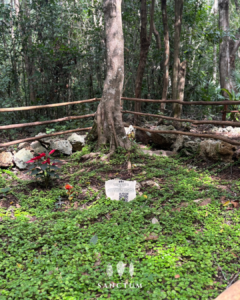
Natural memorial spaces offer an alternative for families who wish to connect remembrance with trees, gardens, and living landscapes.
Rather than associating every visit exclusively with sadness, some families find that these surroundings provide opportunities to remember with peace and gratitude.
A sanctuary can become a place to gather on anniversaries, birthdays, or other meaningful occasions.
 A Farewell Ceremony at Sea
For those who found freedom and serenity in the ocean, the sea can represent a deeply symbolic farewell.
The horizon, the sound of the water, and the vastness of the landscape create a distinctive setting for sharing memories and offering words of tribute.
Ash scattering and sea burial ceremonies must comply with applicable legal and environmental requirements.
 A Family Memorial Space
Some families prefer a dedicated place where several generations can be remembered together.
These spaces can symbolize continuity, belonging, and the preservation of family history over time.
There is no single option that is right for everyone.
The most meaningful choice is one that respects the wishes of the person who has passed away and the needs of those who wish to honor their memory.
Sanctum Forest: Where Love Finds New Ways to Remain
In Cancún, Quintana Roo, surrounded by the natural beauty of the Mayan jungle, lies Sanctum Forest, a sanctuary dedicated to remembrance, tribute, and legacy.
A place created for families who wish to honor their loved ones through a more meaningful connection with nature.
Here, the placement of cremated remains can be accompanied by personalized ceremonies that reflect each family’s story, beliefs, and wishes.
Beyond choosing a physical resting place, the intention is to create a tribute that truly matters.
One that celebrates not only the moment of farewell, but the entire life that came before it.
The Sanctuary: A Place to Remember Among the Trees
At Sanctum Forest, families can explore different memorial spaces within a peaceful natural setting.
Tributes may incorporate meaningful elements such as:
- Letters dedicated to a loved one.
- Words of gratitude and shared family memories.
- Floral offerings.
- Music with personal significance.
- Moments of reflection and silence.
- Blessings or spiritual guidance, according to the family’s preferences.
Each ceremony can be personalized to reflect the individual being honored and the features of the selected service.
For some families, returning to a place surrounded by trees becomes a beautiful way to keep memories alive.
Altamar: A Farewell in the Heart of the Caribbean
For those who feel a special connection with the ocean, Sanctum Forest also offers Altamar, a memorial experience dedicated to placing cremated remains in the Caribbean Sea.
The ceremony takes place during a boat journey and may include a guided tribute, moments for sharing memories, a floral offering, and the placement of ashes using a biodegradable salt urn.
Each experience follows the selected service arrangements, navigation conditions, and applicable regulations.
The sea becomes the setting for an intimate and meaningful farewell.
An opportunity to celebrate a life while looking out toward the horizon.
How to Prepare a Farewell Ceremony Before the Year Ends
If you are considering a memorial tribute during November or December, you can begin with a few thoughtful steps.
First, talk with your family. Listen to what keeping the ashes means to each person and what they hope to experience through a ceremony.
Then, remember your loved one’s wishes. Their beliefs, favorite places, and personality can help guide you toward a meaningful choice.
Explore the available options. Learn about memorial spaces, ceremonies, requirements, and the conditions of each service.
Choose the details of the tribute. A photograph, a song, or a letter can bring deeply personal meaning to the experience.
And above all, respect your own timeline. If you wish to hold a ceremony before the year ends, you can begin planning. If you are not ready, you can wait.
You do not need to turn a date on the calendar into an emotional obligation.
A New Year Does Not Mean Leaving Those We Love Behind
When December arrives and we begin saying goodbye to another year, we may find ourselves reflecting on everything that has changed.
The people we met.
The moments that brought us happiness.
And those we wish could still be by our side.
Perhaps the ashes of someone you love are still at home.
And perhaps, for a long time, that was exactly where you needed them to be.
But if you are beginning to imagine a different place—a garden surrounded by trees or a ceremony overlooking the sea—you can allow yourself to consider that possibility.
Not because you need to close their story.
But because you want to continue honoring it.
Because love does not depend on an urn, a place, or a date.
It lives in the lessons that remain, the photographs we treasure, and the stories we continue to share.
And sometimes, finding a special place for their ashes is also finding a new way to celebrate everything their life meant to us.
Sanctum Forest: Every Story Deserves a Place to Remain
If you are considering giving your loved one’s ashes a special resting place before the year ends, Sanctum Forest is here to help you explore the available options and create a tribute that honors their unique story.
Our services include:
🌿 Memorial Sanctuary: Natural spaces for the placement of cremated remains and the preservation of cherished memories.
🌊 Altamar: Memorial ceremonies in the Caribbean Sea using biodegradable urns.
🕊️ Personalized Farewell Ceremonies: Meaningful tributes incorporating symbolic, spiritual, and family traditions.
🐾 Pet Memorials: Special spaces to honor the companions who left unforgettable paw prints on our hearts.
🤍 Pre-Planning Services: Thoughtful options to plan ahead and provide peace of mind for your family.
✈️ Repatriation Services: Assistance with national and international arrangements for bringing loved ones home.
You do not have to make this decision alone. Allow us to accompany you.
📍 Cancún, Quintana Roo, Mexico
📞 WhatsApp: +52 998 205 4444
📲 Follow us on social media:
Instagram: @sanctumforest
TikTok: @sanctumforest
Sanctum Forest. A place where stories live on.
